

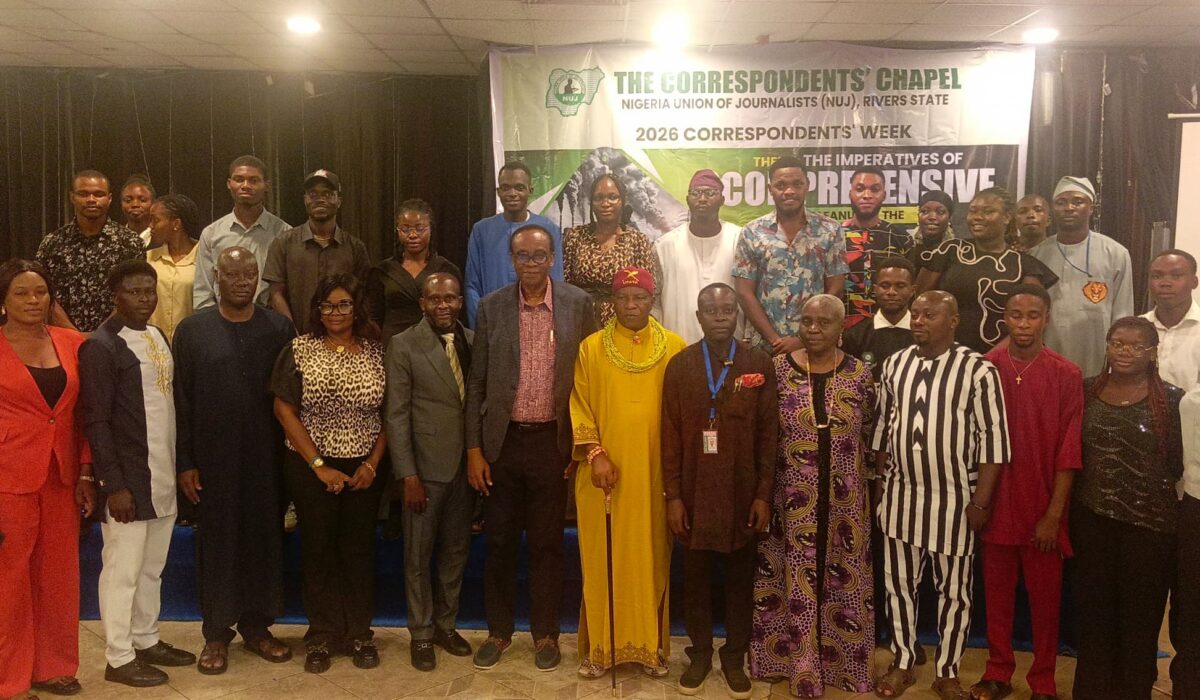
Environmental stakeholders and journalists have called for the immediate expansion of the on-going clean up of the Niger Delta environment beyond Ogoni land to cover other polluted areas of region.
The demand follows the results of several research across some parts of the polluted areas which show that several years of environmental pollution has continued to devastate livelihoods and worsen socio-economic challenges across communities in the region.
They also stressed the need for sustained media attention on environmental issues affecting the Niger Delta, noting that consistent reportage remained critical to drawing national and international attention to the plight of affected communities.
The stakeholders spoke on Monday during the opening ceremony of the Correspondents’ Week organised by the Correspondents’ Chapel of the Nigeria Union of Journalists (NUJ) in Port Harcourt, Rivers State.
The event, themed, “The Imperatives of Comprehensive Clean-Up of the Niger Delta Environment: Role of the Media,” was supported by Renaissance Africa Energy Company Limited, Nigeria LNG, and Kebetkache Women Development Centre.
In his Keynote address, Dr. Nnimmo Bassey, Executive Director of Health of Mother Earth Foundation (HOMEF), and foremost environmental activist in Africa, who led groups in the environment ecosystem declared that now is the time to start the audit of the environment of the region and kick-start cleanup.
He noted the volume of spillage in the Niger Delta in one day was equal to the entire Alaska oil spill, the Deepwater Horizon oil spill of April 20, 2010 caused by an explosion on a BP-operated drilling rig in the Gulf of Mexico which killed 11 workers and lasted for 87 days, spilling 134 million gallons of crude oil into the ocean.
He said the silence of oil authorities, regulators, the political leaders, etc, was deliberate, to lamenting “Nobody cares about the environment of the Niger Delta.”
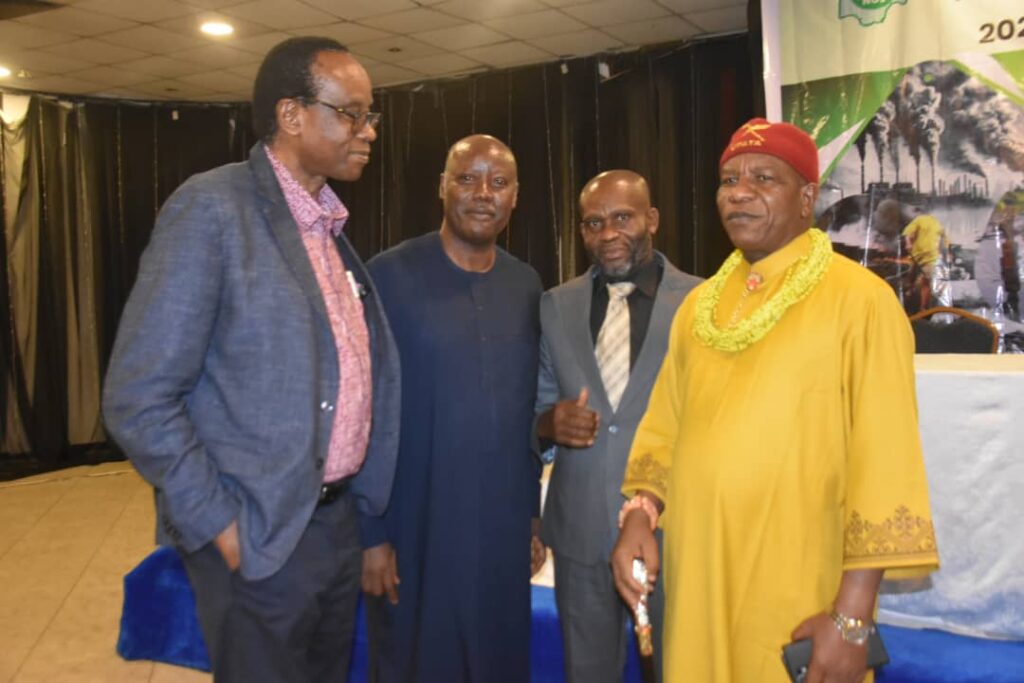
The renowned environmental activist declared at the Press week that Nigeria was economically and socially better off before crude oil became the country’s dominant source of revenue.
Bassey argued that oil extraction merely deepened colonial economic structures in Africa where raw materials were exported while local populations remained impoverished.
“Extractivity is colonial, just like the idea of cash cropping. Instead of cultivating okra, yam and so on, you are planting cotton, cocoa and you don’t make chocolate. You export and make money with no food to feed yourself.”
Bassey also warned that Nigeria looks likely to abandon the Niger Delta to permanent ecological devastation if urgent environmental cleanup was not carried out before the world eventually phased out fossil fuels.
“So, now, the issue of transiting away from oil, whether we like it or not, oil will one day be phased out. Now, when that happens, what will happen to Nigeria?” he asked.
“Is it when oil is no longer needed that we’re going to find money to clean the Niger Delta? No, we will not.
If the Niger Delta is not cleaned now when people are still buying oil, then we are sold.”
He accused multinational oil companies of profiting from environmental destruction while communities suffer pollution and poverty.
“Clean up the mess. Nobody has the right to poison water, poison our soil, poison our air, and then run away to the bank with profits. That is totally immoral and unacceptable,” he stated.
Bassey specifically named major oil operators, insisting that all companies operating in the Niger Delta must be held accountable for environmental degradation and rejected the routine attribution of oil spills to vandalism, insisting that ageing pipelines and operational failures account for many incidents in the Niger Delta.
In whatever case, he said, the oil majors must take responsibility.
In his remarks, Paramount Ruler of Upata Kingdom, His Majesty King Felix Otuwarikpo, Ph.D, Eze Igbo Upata III, called for an amendment of the Petroleum Industry Act (PIA), arguing that certain provisions unfairly hold host communities responsible for oil theft and pipeline vandalism.
The monarch explained that although Section 437 of the PIA allows part of the host communities’ fund to be used for repairs of oil facilities damaged through sabotage, oil companies have continued to depend largely on security agencies to protect pipelines while sidelining the communities.
King Otuwarikpo also accused the Federal Government of failing to give adequate attention to the environmental and developmental challenges facing communities in the Niger Delta.
He called for stronger collaboration among stakeholders to ensure effective environmental remediation and improved living conditions for people of the oil-producing region.
“The environment is very key and attention is usually not given to the environment because most of the consequences we suffer at the community level do not happen at the GRA,” he stated.
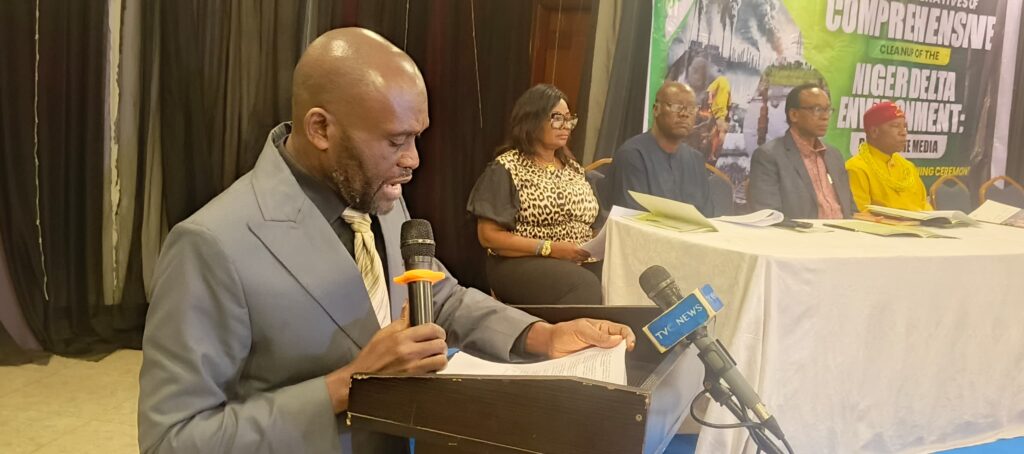
Speaking earlier, Chairman, Correspondents’ Chapel, Mr. Amaechi Okonkwo, stated that the event is not just another ceremonial gathering, but a solemn call to conscience.
“It is a call to action on one of the most critical issues confronting our region and indeed our nation, the continued degradation of the Niger Delta environment and the urgent need for a holistic and comprehensive clean-up,” he said.
Okonkwo observed that the Niger Delta remains one of the most environmentally devastated regions in the world despite being the economic backbone of Nigeria for decades.
“Our land, rivers, creeks, and forests have suffered extensive pollution arising from oil exploration and exploitation activities, illegal refining, pipeline vandalism, gas flaring, and years of environmental neglect.
“Communities that once depended on fishing and farming for survival now struggle daily with contaminated water, destroyed farmlands, loss of biodiversity, and serious health challenges.
The painful reality is that many of our people continue to live in conditions that fall far below acceptable environmental and human standards,” he said.
