

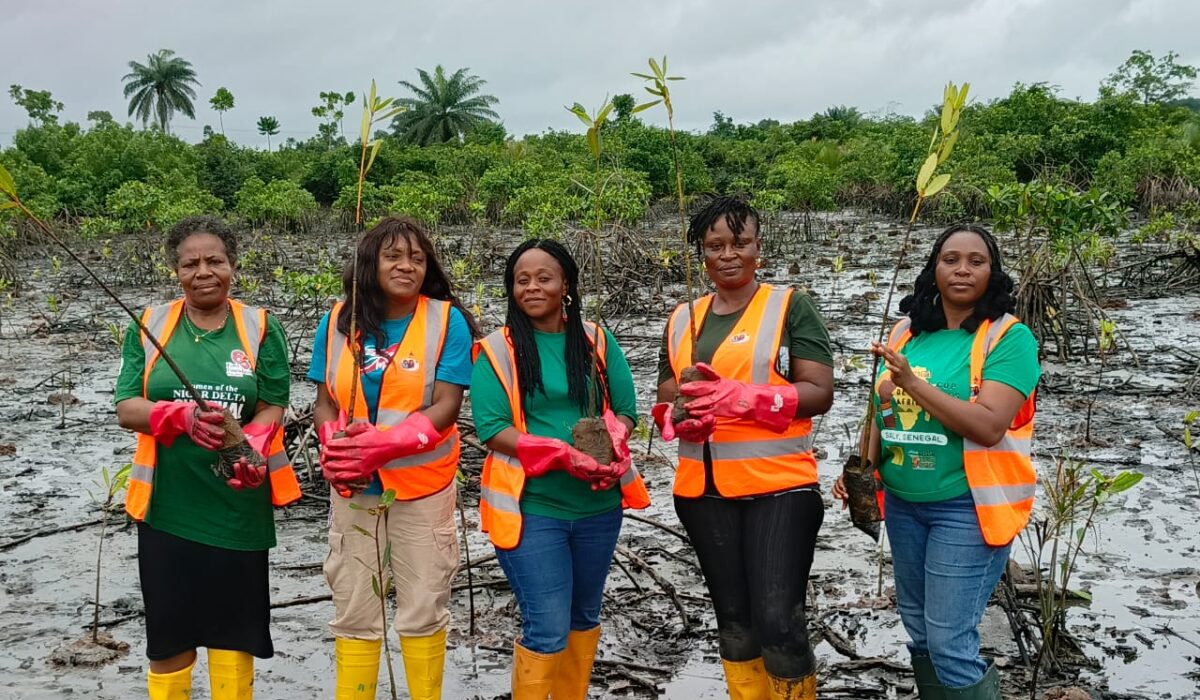
Non-governmental organisation Kebetkache Women Development & Resource Centre has launched a drive to plant five million propagules in communities across the Niger Delta as part of a long-term initiative to restore oil-degraded coastal ecosystems in the region.
The ‘5 Million Mangrove Campaign’ was flagged off on the commemoration of the World Mangrove Day, on July 31, 2026, in Tai Local Government Area of Rivers State, with the Kebetkache team leading local collaborators, environmental experts and others to plant 5,000 seedlings in Kporghor and Gio communities.
The team, which began planting 2,000 seedlings in Gio on July 31, continued in Kporghor on September 15 with 3,000 more seedlings.
Program Manager, Mary Alexander, described the campaign as both an environmental justice intervention and a livelihood recovery programme for communities that depend on fishing, periwinkle harvesting and other waterfront activities.
“For communities such as Kporghor, where people depend on the waterfront for fishing, periwinkle harvesting, crabs and other seafood, the destruction of mangrove vegetation has direct consequences on food security, household income and the survival of aquatic species,” Alexander said.
According to her; “Rather than being a one-off intervention, the campaign represents a sustained commitment by Kebetkache to restore biodiversity, strengthen climate resilience, improve community livelihoods, and promote community ownership of environmental conservation in oil-impacted communities.
“The campaign is not simply about planting trees; it is about restoring the relationship between communities and their environment, strengthening local ownership and ensuring that the coastal ecosystem is preserved for present and future generations.
“For Kebetkache, mangrove restoration is not just an environmental activity. It is a response to the impact of oil extraction and environmental degradation on coastal communities’ surroundings”.
Alexander stated that, beyond the symbolic planting of mangroves, the initiative empowered community members “with practical knowledge, strengthened local ownership of conservation efforts and introduced green livelihood opportunities capable of improving household incomes.
“As Kebetkache expands the campaign to other Niger Delta communities, the organisation remains committed to working alongside local people to restore degraded mangrove ecosystems, revive biodiversity, strengthen climate resilience and ensure that future generations inherit healthier and more productive coastal environments.
“The campaign reinforces the message that environmental restoration is a shared responsibility and that sustainable conservation can only succeed through continuous community participation, commitment and collective action,” she said.
Environmental Expert, Dr Philip Kalio, explained that mangroves serve as breeding and nursery habitats for numerous aquatic species such as fishes, oysters, crabs and periwinkles stressing that restoring the mangrove ecosystem is critical to reviving biodiversity and rebuilding community livelihoods.
Kalio noted that mangroves provide significant climate benefits by acting as natural carbon sinks that trap and store carbon emissions, thereby mitigating the impacts of climate change.
He warned that the indiscriminate cutting of mangroves for fuelwood and construction purposes continued to threaten the ecosystem and increased environmental vulnerability.
The event brought together community members, environmental experts, and other participants in an intensive capacity-building session on mangrove restoration, conservation and nursery development as a sustainable livelihood opportunity.
The campaign began with a training and planting exercise in Gio and Kporghor that brought together 57 participants, including 44 community men, women and youths, 13 Kebetkache staff and environmental experts.
A follow-up restoration exercise on 15 September 2026 in Kporghor saw 30 participants—six Kebetkache staff and 24 community members—plant an additional 3,000 seedlings under a 500-a-day plan, taking the cumulatived total in Tai LGA to 5,000.
